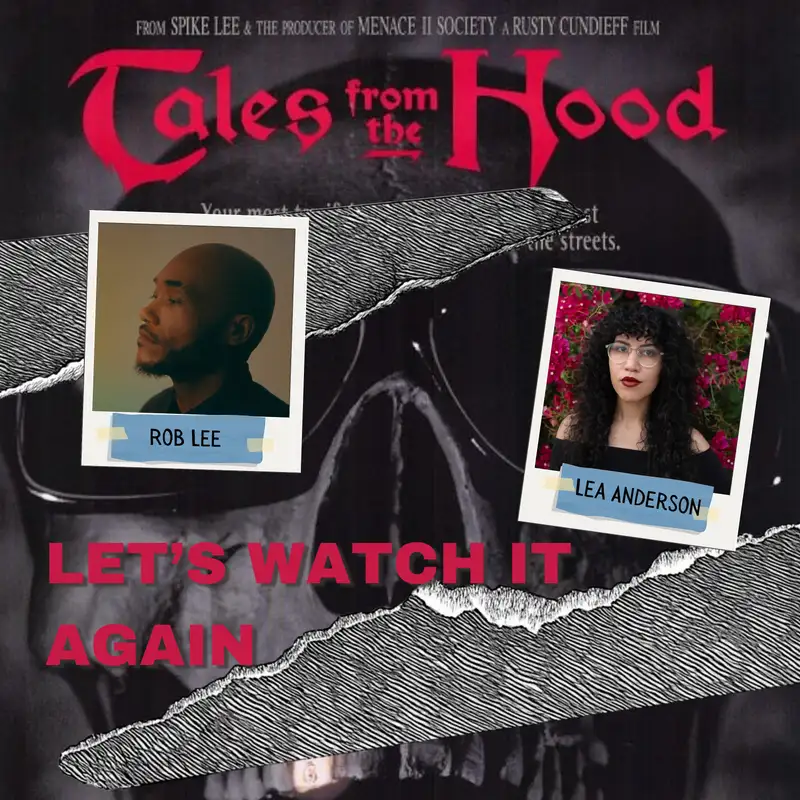
TALES FROM THE HOOD (1995) A Film Retrospective with Lea Anderson
Music
Speaker 1: Bless you all, brother. In this neighborhood is a house where souls never rest.
Speaker 2: You're invited to share their secrets. I've been waiting for you boys.
Speaker 1: You're invited to share their tales. Unless of course, you're scared.
Speaker 2: Tales of madness. Of revenge. The girls don't want you there. They want reparation. Of horror. He thinks he needs to kill the monster. Now, your most terrifying nightmare and your most frightening reality are about to meet. On the streets.
Speaker 3: And this is a trip, homie. I don't need nothing or house of dare folks, okay? Death. It comes in many strange jackets.
Speaker 1: The producer of menace to society. And executive producer Spike Lee. Will take you to the outer limits. Of the inner city. Welcome. The cow. Tales from the hood.
Speaker 2: Chill. Or be chilled. I mean, I don't need to be hearing this, man.
Speaker 1: Written and produced by Darren Scott. Written and directed by Rusty Cundieff So we're back.
Speaker 3: Thank you for coming on, Lea Thank you for having me, Rob. Thank you for being back on Let's Watch It Again. This is the first time in a little while, I just set the stage for folks that have been following along.
The last movie that I did on this particular podcast was Kill Bill Volume One. And it was the first year of that. So this is two years ago. And this is sort of a special Halloween treat. And we are doing Tales from the Hood.
lea anderson: Yeah. Black horror classic.
Rob Lee: 100%. 100%. And it's one of those things where it's the 30th anniversary. It came out May 1995 is what I saw. I did see 94 at one point, but I was like, I'm going to go with 95.
lea anderson: Yeah, probably 94 could be if it like had a festival premiere. And they showed it prematurely. But yeah, I think the later one would probably be the white theatrical.
Rob Lee: White theatrical. That's what I like to call myself the white theatrical. So probably watching it, you know, I hadn't seen it in a couple of years. And, you know, there's a few things I want to set the stage with just going off. I didn't know that like one of the production companies was like 40 acres in a mule. I should have known that, but I didn't initially.
I was like, hold up. You know how you're watching something that you've seen before and several times that you're watching it more from a critical lens or watching it for notes and research. You see things suddenly. Yeah.
lea anderson: Yeah. The details, the devil in the details pops out.
Rob Lee: I like what you did. I like what you did to see. Look at this foreshadowing. See, this is why you're the right person. Further, that's one. So, you know, going to this movie, I'll give you sort of the details and I want to, I'm already going to have a request for you, but we'll get there.
So written and directed by Rusty Cundiff. And it has, you know, just some of the folks that pop up. You had Clarence Williams, third. You had David Allen Greer, you had Corbyn Berenstin, Rosalyn Cash, a bevy of other folks. But those are just a few. It's kind of got this because it's broken up in different stories and anthology sort of vibe. It's like several folks that you got Guy Torrey pop up. You have Caffeine. I call him by his rap name.
I call him by his rap name. So this film had a $6 million budget. It made almost 12, 11.8. And it came out against, this is where I got, I got really into the minutia. Do you remember what it came out against?
Speaker 6: No, 95. No, no, no, no, main 95. These are some good ones.
lea anderson: Casper. Oh man. Casper is classic though. Braveheart.
Speaker 6: Oh no.
Rob Lee: And Johnny Mnemonic. Oh no. And Johnny Mnemonic.
lea anderson: Wow. Okay. Well, they had, they had a cornered really, you know, there was kind of no losing on that, on that release weekend.
Rob Lee: So this is, this is where I'm going to need your, your expertise here. Just so I have sort of what I found as though to the synopsis of the film, right?
But I want you to put your, your, your critical like hat on, you know, this, this great mane of hair that you have. And tell me this is accurately depict from what you've watched. So, you know, Tales from the Hood. This is what those synopsis, a
Speaker 7: funeral director tells four strange tales with an African-American focus to three drug dealers. He traps in his place of business.
lea anderson: I mean, you should have been recording for way back when, when like around when, when Tales from the Hood would have come out the, the movie line, movie phone, is that what it was called when you, you called in for, for show times? Yeah.
Yeah. You have an amazing voice for that. Or maybe you could revamp the mortician because that too. I'm sorry. The, does that in a very stiff way, but Tales from the Hood is a lot funnier and a lot campier than, than that synopsis would make it seem. You know, if you drain all the life blood from it.
Rob Lee: It's, it's very campy. And so there, so one of the things in it definitely touches on it almost from a purely informational standpoint. So your, your campiness as you touched on is just not in there.
I mean, we start off with some of the funniest dialogue and that intro of welcome to the mortuary, the prologue. And I mean, the names of the drug dealers are ridiculous to me. Stack, ball and bulldog.
lea anderson: Sometimes I'm terrible with names and sometimes I'm like, is this because I'm terrible with names or is it because the names are ridiculous and they like don't register as names? Nope. But, uh, Mr. Sims, he sticks around. He definitely offs out.
Rob Lee: 100%, 100% and take with two M's on Sims. So we're in the mortuary. And I mean, he's his visual is the name for this movie as we carry it 30 years later.
Like, you know, any artwork I've seen around this film, not the sequels, we'll talk about that probably, but it's him as Mr. Sims. So we start off with this sort of introductory story. Each one has a, a title for like a chapter, if you will. So this first one is called Rogue Cop Revelation. Could you kind of summarize that if you will? Give us a little bit of.
lea anderson: So the, the first tale of Rogue Cop Revelation is, um, it's sort of spiritually reminiscent of Candyman. So basically we're introduced to Martin Morehouse is his name, I believe, if I'm remembering correctly, who is an activist and politician. And we are meeting him after he's been, uh, after he's been pulled over by a bunch of cops. And it's a scene of police brutality takes place. Um, and what sort of twists in the scene is that one of the cops is also black. And so we're looking at like the dynamic of, it's really narrated through his perspective. So we're really looking at the, at the problem of police brutality through the lens of someone who was both inside and outside.
Yeah. So, um, retribution occurs a year passes, uh, Clarence, who is the black cop. He is haunted by what takes place that night. He has left the force and, um, Morehouse starts to call to him in, in his dreams, um, almost like a haze. And, uh, and then justice takes place.
Speaker 8: Now let me ask you something, huh? You getting off on destroying good cop's lives? You big mouth, God damn son of a bitch. I've got nothing against good cops.
Speaker 1: You what? I said I've got nothing against good cops, but I will see low life scum like you run out of the department.
Rob Lee: This is, this is great. And I love the just it, it keys in on it. It sets it because the sort of stage of the film is even going back just as coach of sort of the mid nineties gangbanger sort of West coast thing. And then we get to sort of this story, which is familiar and it's almost the he, he, he's not great, but it's almost the chappelle bit of sparkles and crack on them. It's like, Hey, we're going to put Morehouse in this car and have like drugs in the system. It's like, so this is the death. And, um, and yeah, the, I wrote this down too. I was like, yeah, you're a robot. Yeah. I wrote that. And for a second, you know, I feel a little bad for Clarence. But then a cab. So side too little too late, which
Speaker 9: it's, I think that, I think that there's value.
lea anderson: So we'll just talking about like the project of the film overall, like the, um, um, because it's sort of like three tales and then the frame story and the frame story. I think the technical, I think the technical word for that is wrap around. Like, I think that's what they refer to it in the, in, in like people who are really into anthologies or who make anthologies. Um, but yeah, this is, uh, it's really concerned in the sort of frame story with this idea of being scared straight. And so there's, these are, these are cautionary tales. They're morality tales. And so I think that was like a very intentional choice to make Clarence the center of this where it's like, we see the situation you're in of like this choice of, you know, how to earn a quote unquote honest living, but then where is the honesty in that?
And like, what do you have to sacrifice in order to, I don't know, in order to achieve this sort of vision of the American dream that involves like the middle class, which is, you know, non-existent anymore. Um, this is very much so like a product of its time. But yeah, it's also definitely intersecting like hip hop, like the specific era for hip hop and, uh, and horror core being like the soundtrack is fucking awesome.
Um, so yeah. I think all of those tensions are like very, very present in, in that first story about like justice and I think masculinity is a big part of it. Like the bonding that happens like between the cops and like the sense of themselves when you start like really doing close readings and paying like very, very, very close attention to it. Um, yeah. And that adds very, very critical of, of all of that positioning.
Rob Lee: Cause he definitely with the cops that had an hierarchy thing going and especially the one dude, uh, the mustached cop, I'll say. Yeah. It's like, yeah, get over there. I, you know, I just finished, uh, urinating on his grave. So you do it too. And I was just like, all right. It's, right.
lea anderson: And it's so, I thought that detail was like the, the like perversity of it. Um, it's just like the, I think that the, the sort of, um, sugar coated euphemistic way of putting it is like peer pressure, but that doesn't actually, we don't leave that behind in childhood, right? Like that is so much a part of like social bonding as adults is like, you still have the sort of who has power, who has dominance in the room.
And in this case, it's a matter of like, this affects your life. Yeah. You know, like, like this dude is violent and vindictive and we know everyone knows this about him, but still like what deal with the devil are you making? What, what is, what is better at the end, at the end of the tale, um, after, you know, they're all dead.
Um, I love the, the confrontation between more houses. I don't think of him as a ghost. I think he, that he's like a haint, like pretty, pretty in, in like the truest definition or distinction. Um, um, there's a confrontation between more house and Clarence and Clarence asks him, are you satisfied brother?
And he's like, he just throws it back at him and says something like, where were you when I needed you brother? Yeah. And that, and that's, that's kind of the whole thing, right? Yes.
Rob Lee: Cut to him institutionalized. And I love that it was a little like haint, stank on it, if you will. I was like, Oh, okay. Yeah. Yeah. Even in the, the undead or the afterworld is just like, nah, bro, this ain't gonna work. You did that. And that's great. And the, the use of the street art or what have you again, that you keyed in the candy man thing again, I kind of just saw sitting there. Yeah.
lea anderson: That's such a, it's such an interesting motif and like thread through all of the tales. You see how like art and portraiture in particular hold like real power. And that's, that's one of the, I think like main through lines through the whole film, all of the tales sort of contend with it in different ways, but it's like one of the main preoccupations of the film.
Rob Lee: For sure. So I'm going to save these for later. I had a couple of questions, but I'm going to hold on to that and come back to that because I think it makes sense to cover the other tales and then go back into that. But one quick observation I'll share before I move into the second tale is two, two observations. One I like that in the prologue, a few things were keyed in on of, I think it was Guy Torey's character or no, sorry.
It was a Joe Torey. Since I really went this funeral home, which I was like, I was like, Blackfield or like funeral homes. And I ain't really messing with the dead. I was like, that's another one right there that's just sitting there. And lastly, I'll say like, oh, so caffeine, you know, has worked. Things to say he's not getting stomped out like in every other movie I've seen him in.
lea anderson: I love the, the refried beans joke that could like something being twice dead, how you kill something that's already dead. It's like refried beans. Yeah, fuck him up. You can refried some beans for the deliciousness, you know, it's good.
Rob Lee: It's good. So here's the next one, which is titled the next next tale. Because we're going further in as far as the wrap around, we're going further, you know, into looking at another casket, each one of these tales that's set up with a casket while the drug dealers are there looking for the aforementioned shit.
I can't put the same. So this is called boys do get bruised. And this is sort of a tale where it's a, you know, it's a young boy in the class. He has these bruises. It looks like he's like having issues adjusting to like this new school or have you.
But it turns out he's probably getting bruises from at home. And we later learned that it's David Allen Greer. As I called him, dark Greer, by the way, whenever I see someone who's generally known for comedy and I see them doing something else, it's like, this is dark Greer right here. This is the shadow itself.
Speaker 9: And it's sort of like, I think he's in a couple of things like I know from from me and even like my nephew, right? Like, you know, Justin, I used to get picked on and bullied at schools. I thought initially it was going to be that. And it's like, oh, you know, it's a new school.
And I say, ah, being a new kid stinks. But then it turns out it's not that it's something a bit more supernatural, I guess, going on here through art again.
Speaker 9: It's I really, I really love this
lea anderson: tale because I'm really interested in monsters. And I think that it's kind of like a perfect demonstration of the subjectivity and the complication of like how you constitute a monster. And yeah, it's it's that question of like the supernatural at play. To me, this is maybe that no, because they're all pretty grounded in like reality and the real. But this one is, I guess, it's part of its introduction is like that question of like what is perception and what is reality and how to sort of delineate them. And then having a child protagonist where, you know, there's like all the superstition that like children are more sensitive to the paranormal because they're closer to the veil, they're newer on earth.
And so they're just like more sensitive to that. I think the same is sort of true with poetry and with like the sort of figurative metaphysical, metaphorical ways that things that are not real can still be real in reality, like in material reality. So he's drawing at school these images of monsters that he's saying he's saying this is who is leaving the bruises on him. And his teacher doesn't really understand because, you know, he's an adult and monsters aren't real, right? But that doesn't mean that the monster isn't real. It doesn't mean that it's in his imagination, because as we learn, the monster is very much so real.
And one of the one of my favorite scenes in the entire film is when is when the monster is entering the room and it's casting the shadow of the monster and then it's just not clear. And and it's not it's not a just it's like. Oh, shit. Yeah. You know.
And yeah. So then it calls into question, you know, like how do we conceive of a monster? And then the next question, how do you like solve the problem of the monster? Like how do you deal with the presence of the monster once you've acknowledged that there's a monster in your midst?
Rob Lee: You treat him like a bad draft.
lea anderson: So this was one of the details in this rewatch that I had never I hadn't thought about this before, but it's so connected to I think that this is like.
Sturdy for people for the folks who are into astrology. This is like a common practice about like with like banishing or like protection is this idea of like writing something down, putting something into paper. And then burning it or destroying it in some way to sort of like banish it. And seeing that as the like. The survival strategy, it really goes back to that that general sort of overarching preoccupation about like the power of art to in this case, vanquish monsters. Absolutely.
Rob Lee: Absolutely. So it's a couple of observations that I made just because of the way my brain works. So there's a scene earlier when like that first like asking him about the bruises and what happened. I was like, there's an unlimited color scene.
There's a universe where this is fully just in living color, you know, where the nurse is uncredited, but she was one of the players on the living color. So. Oh, shit. So you have her and you have David Alangren and a sketch. I was like, there's a universe, right? Where this gets go, her completely comedic bent and it just doesn't go there. It just is still just just dark. But nurse Parchman is to Kia. What is it? To Kia, Crystal Kema. She was on and living color, one of the original players for the all four years.
lea anderson: It did not catch that. That's damn. It could almost be like a Halloween episode, like a scary shadow Halloween episode. Everyone's like the worst version of themselves. We're off this week.
Rob Lee: Let's see. I wrote this down because I thought it was funny. It's because, you know, you got to with, you know, sort of stories like this that, you know, it's like, it's okay. I didn't beat up a spad and the David Alangren character. He's not like slapping people. He's going full punch punch.
lea anderson: Oh, yeah. Yeah. The violence in this movie is like it's I thought about this a lot. It's it's interesting because it is pretty brutal, but it it's not. It doesn't look realistic. Yeah. And I think that's really important. I think it strikes kind of like a perfect balance of the two. If you're going to deal with these themes and these subject matters that are really intense and really discomforting, discomforting, I think is the word. Then the the sort of balancing that out with.
Not having it like looks so grotesque. Right. Right. But no, he like takes his belt off and he is like going at it. Like it's not it's not casual violence. It's it's pretty extreme.
Rob Lee: And I mean, it is it's an equal opportunity to us. I mean, because, you know, initially you're like, oh, you're a version of a cow where you're going to pick on a kid and oh, no, you beating up the teacher as well.
You kicked him in to stove. I was like, his light skinned dreads one fly. And I was like, this is. But it's a it's a part in there where his response to being drawn. I felt like it's like, is he an art critic? Is he got really offended? He said, you draw people. I was like, oh, man, he's like, you're really going to get it. I was like, he doesn't like his rendering.
lea anderson: Well, well, this is I think that may have been a little bit of like a throwback superstition when about like the fear of photography. Do you know about this when when photography was developed?
So so there is a belief when film cameras and like the practice of photography, as that was all being developed throughout the 19th century, there is a belief in a superstition that they saw that they would steal your soul, that the image every time an image is captured, that it steals part of your soul. So there's kind of like. There it's sort of talking back to that. Yeah. But maybe I might just be reading. Oh, no, no, no, no, thanks to.
Rob Lee: I'll I'll just give you these two to sort of like time things. I think you might find interesting. So David Allen, Grant, I wrote this time down, dark gray, if you will, enters at minute 43. It goes full body horror in many minute 48. So he's kind of in it for like five minutes. And he gets all twisting.
lea anderson: He gets up like he looks like a like a plate of scrambled eggs. It's it's incredible. I'm just, you know, practical effects people like nothing beats it. Um, that's wild. That's wild. So impactful. Yeah. Yeah. And in that time.
Rob Lee: And just a minimal sort of runtime because the movie all in all, all in the movie, probably sans credits is probably 88 minutes. You know, so getting. Yeah, it's tight.
lea anderson: It's tight. It's got a super. It has a super tight script, though. Like it's it's one of those. It's a real like poem of a film. Like it's really, really, really tight. Get out is like that, too. Like the script is chiseled. It's chiseled. There's like no X. Everything is doing something. Everything is like working towards its end, which I love. Very satisfying to the poet.
Rob Lee: So two of the things, one, I like the touch of the monster tattoo in his forearm. I like what we get to see. I say, yeah, they're really getting it across.
Yeah. And I just like at a point where. What he says something like just wild to to was like an under name, like an under name. What do we got? What's the name?
Paul Lajai Park. He says that while David Allen character says something wild to her like, I'll kill you, bitch. It's something like that. I don't know what it was, but she squashes his face in like a bug, which is great.
But I love the sort of Rusty Cundiff who earlier was like the teacher earlier. It was like, maybe you just got weak bones. I don't know. I was like, so you know what we've got to do, right? It's like just an acceptance. We're about to torch this dude. That's not like, oh, no, no, we're here. We're here now. We see it. We're not doing. But what if no, no, no, this is.
lea anderson: No, well, they had done the what if beforehand. It was so much like. I don't even know. I think it might be part of like protocol now that like you don't do something like that, you don't go and like seek out the parents and like go to a student's house now because you could potentially be putting them in danger if you suspect domestic violence is at play, which like all the telltale signs. In fact, after the first one, he gets when Walter gets beaten up on the playground and he goes to he's at like the nurse's office. They they the teacher asks if he's OK and the nurse responds like, yeah, he's got a thick head and it's like cheeky and sweet, but it's also like. You know, that like, like you feel you feel for the child's in a scenario when it's like and that's kind of the I don't know the heart of of the whole second tale is that kind of like this poor kid and he's so vulnerable and we see him like in his bed crying at night and like, you know, the monster wobbling the monster at his door and he's just like helpless. And then, you know, when he enters and he's like towering in in the corner, I think that it really. I think that kind of did an excellent job evoking black children as children. Truly as a child, because that's a difficult thing for a lot of people.
Like they there's that tendency to not see black children as children or to project strength or like age or maturity onto them that they don't necessarily have. And so I think that he does a really incredible job of keeping Walter. Soft and young and then empowering him in this kind of absolutist way where it's like, all right, everyone's like made the excuses and like temper the situation, but now we're going to solve this problem. Now he's going flat. Yeah. Yeah. Yeah. And no one needs to know about it.
Rob Lee: Yeah, let's give no one's looking for him. So we have the second wrap around here. Back at Sims, back at Shaysims, at Sims, we're at home and we get the calls burnt and mangled corpse because that's David Allen Grish character is revealed often. They close the casket, the the gangsters. And then we get a doll, which is where I started to kind of get a little annoyed and a little bug doll. I don't really bang with the dolls.
So we'll talk about that in this next part where we get to the third tail, which little on the nose, but also I like alliteration. This is called KKK comeuppance. This is the name of this particular one.
Speaker 9: We said it was campy. It's campy.
Rob Lee: It is. And could you could you give us sort of like your synopsis?
lea anderson: Um, my synopsis, a former Klansman is running for governor and he has moved into the into the main house of a former plantation and the community is outraged because a massacre had occurred there during the end of the Civil War as he informs us and the the souls can no longer rest with his presence there. The details of it, we meet the Klansman governor with his like his like media strategist, who is also a black man. Um, yeah. So so much like the first segment, the first tail, Coonery is punished in Contips Universe. Great.
Rob Lee: This is great. Thank you. Thank you.
lea anderson: There's no making it out. While Coonery, because I believe the word he says to Corbyn Burnston's Duke Metger is, yeah, I'm going to soften the edges. It's like, what? He was he was a grand dragon or something. What are you saying? Yes. And then the edges are like, you know, a blade.
It is ridiculous. So so in this with with the house within the main house is a portrait of a conjurer woman who purportedly after the massacres took place and after the house was abandoned. That the legend, the story goes that she came in and she transferred the souls of the enslaved people who had died there into these dolls.
And so the local community story is that, you know, the that that this house is not, I don't know if I would call it a haunting, but it's it's possessed sort of by by the by the spirits and the souls of the people who died there. So, yeah, the the Klansman doesn't learn the first time. And so he has to get his comeuppance. And it's really, really satisfying to watch.
Rob Lee: I'll just throw this in there. You did a great job giving us that that summary there. I wrote a few things now because like like while like, you know, my dad back in the day, he used to traumatize me and my brother, like I say that facetiously with like puppet master. He's like, oh, let's we're gonna watch. Why are we doing this? So when this came out, not too long after that, I'm like, no, and they're black and they're like eating this dude. I was like, yo, come on, can we can we not? Can we not? Can we say we did but we don't? So I kind of love it.
lea anderson: And I think that the I don't think that this could have been done without the dolls. I think the dolls are like critical to it because there's there's kind of a double standard about uses of violence in horror, right? And like where and who sort of gets to hands out really violent retribution.
And there's you don't see a lot of black folks doing incredible violence to white folks, but we do see a lot of the opposite. But I think there's like, there's really significant and relevant reasons for this, right? Like there's there's art is powerful.
And because it's powerful, it can also be dangerous. And so I think the element of the dolls creates, it's both very campy and creates an element of distance and like fabrication and artificiality and also just like absurdism. Like it's just kind of ridiculous.
It's a ridiculous image like all these dolls descending on this man and then like devouring him. But it's still the point is still made. Does that make sense? It does.
Rob Lee: And I know that that kind of as far as the devouring piece, I know that I pop some of these like radar of a theme that they're just really interested. I don't know who it could be, though.
lea anderson: There's no one here who's just totally obsessed with the devouring monsters.
Rob Lee: I'll just throw these different things in there. I just thought it's observations, but I think you kind of did most of the heavy lifting there. So shout out to you. Let's see. I wrote, watch your step, Mr. Willis up. That's a rapper, Robert Grinnevere Smith. I literally wrote this. I re-rounded in short.
lea anderson: You got to do what you had to. Some moments.
Rob Lee: Art Evans, who plays Eli and one of the folks that are like processing his, you know, Metricorps' hope. I was like, why you got this smoky to bear hat on? You're not supposed to be in this movie.
I think you were late for something else and they were like, we got to get you in here. I was like, he looks smoky to bear. I thought it, I thought some of the stuff with Duke and I kept calling him David Duke Metcour, by the way, was very timely and reminiscent of some of the stuff that we see in the north and sort of like public media. And I always look at the south being a little scarier, just in it. I feel like it just goes down there, but one, timely, the whole, this particular story, timely, because the state of politics, we're just letting sort of anyone with any background that's very dark and very crappy, like KKK person or even Nazis, just go into running our country. I like that his slogan was an original American. Yeah.
lea anderson: Yeah. Yeah. It's almost like this stuff is old and not new or edgy in any kind of a way. You know, it's just the same old, it's the same old story. They've been telling the same story for like three centuries, four centuries. So we've disproved it. We had an entire like this little thing called the enlightenment and the result of all the science came out that they were wrong. Science. Nah.
Rob Lee: So I wrote down this because I enjoy this. I do this thing because I've seen enough Tala Perry movies. I'm always looking for wigs. I'm always doing a wig check. I remember since I've been notoriously like bald and for a while, and I was like, you know, I if when they pull him apart and devour him or what have you, that wig doesn't come off. I'm a deep disappointed. And I was like, come on, the wig moves and it doesn't. It's flopping around, but it's there.
lea anderson: It would have been such a great moment by wigs.
Rob Lee: And I'll say this, the thing with Metcur, he really needed Rody in that he was useless. Even post, literally the speech that he was giving him, don't call black people spooks.
That was essentially what the speech was. He fumbled it the very next day. Who gave reporters like you? I was like, what William S. Barrows? And then the other thing I thought was interesting as far as history goes, when he gets the first doll and he mounts him to the dartboard, the first thing he's going for, I'm going to shoot your n***a balls off or whatever. And I was like, oh, okay, yeah, you know, that thing.
Just, you know, we're going to go genitalia first. I was like, that's the thing. And then I thought about it. I was like, also, you're not good at this either. You're just bad at whatever you do, even the violence you're bad at.
lea anderson: Yeah, that's one of the things that I love about the white villains in In Tales from the Hood is how preposterous they are and how inept they are. And I think that, you know, like you said, very, you know, timely. We're seeing all of this happen in lifetime. These people are not smart. Yes.
They're not smart. And it goes, it's kind of the same thing as in the second tale, that image of like the shadow of the monster on the wall and then it's just a man. We tend to sort of blow evil up into like something incomprehensible and like so completely other. But the reality is that it's like so banal and so boring and so self-evident and really ridiculous. I, there's, there are one of the things I do appreciate is like the sort of subtle nods to how psychosexual all this stuff is to like, like racism is like a psychosexual kind of dysfunction. And when you really get into any kind of like primary source, historical analysis of chattel slavery, then you really, what becomes unignorable is like the perversity of it. And so like, yeah, these kinds of things, they'll, they'll, it's easy to joke about and they'll land as jokes and you can really sort of like soften it and make it funny. But there's still definitely like a weight of real, some really bizarre historical stuff that is, is in actuality outside of like comprehension. For sure. For sure.
Rob Lee: Last thing that I'll chime in on before moving into the next part of the wrap around is just in terms of satisfaction, you touched on this early as far as like, ah, this is just great. This one, the puppets were all out of the picture and his sort of face of realization. I was like, bye.
Speaker 9: You're gonna flip. Come up. Yeah. I was like, this is great. Yeah.
lea anderson: When the, when the conjurer woman, when she like materializes out of the portrait and then materializes in the room, I'm just like, get a man. Just get him. Love. Yeah.
Rob Lee: So here's the, so here's the wrap around just, you know, the, the deal is grown impatient and we're, we're getting to the, you know, the end of things, we're getting towards that end portion. And there's one more story that he wants to share with them. It's about a, you know, a person that they appear to know or know of. We're going to get a little bit, a few more details on that. And then we're going to get into that in the fourth story called a hardcore convert. Could you, could you help us out? Interesting.
lea anderson: That's, I didn't know the titles of them beforehand. That's an interesting title for it. So basically this is kind of where it gets a little bit meta where we're in, we're in the tale that is the frame story, but we don't necessarily know it at this point in time. So they, so, so this is, so this dude is like ostensibly also what they're insinuating is a drug dealer, but it's a really, it's really a tale about gang violence, right?
So he like feels like someone did him dirty. So he goes and he shoots someone and then he gets shot and finds himself incarcerated. And while in prison, he's approached by a scientist, a doctor, to participate in a he might be able to like get out early if he participates in this program. So there's like a history of, of this, right?
Again, a history being conjured of experimentation via incarceration. So they bring him to this like haunted tower. It's like, like the drive, the opening shots of like House on Haunted Hill is, is kind of where they're bringing him. It's very ominous. It's a dark and stormy night. Places like Got Dungeons.
I don't want to be anywhere where there's dungeons. So yeah, first they put him in a dungeon-esque cell next to a white supremacist who basically thinks him for doing his job for him for the act of killing other black folks. And so that there's that confrontation. And then they get into this very kind of any time there's like scientific experimentation going on, it's sort of it's reminiscent. It recalls Frankenstein. But this, I think, is more blockwork orange.
Because of the method of modification. So they basically like strap him down and force him to watch a sequence of different acts of violence against black people. So the way that this is cut is like gang violence cut with imagery of actual lynchings.
Earlier in the first tale, I think we forgot to mention that as the, as the beating is happening, strange fruits is playing over. So there's a there's a very intentional attempt to draw these lines of comparison between the violence that we inflict on each other and the violence that has been inflicted upon us and to sort of confront the legacy of that. And he's sort of being taunted by the scientists of like, what's the matter? Jerome, you don't like images of black people suffering something something to that effect. And then they put him into a sensory deprivation chamber. And in this, he's confronted with like the spirits and the ghosts of the people that he himself has killed. And while it starts with them, it's sort of the ripple effect of that violence, kind of like spans out. And all of these other ghosts appear who are also victims in one way or another of this kind of violence. And it's really about it's it's kind of a terrifying scene, not so much in the way, in a way that's hard to articulate. I've been trying to figure out how like how to describe this.
But when you see someone who is refusing to see themselves and God kind of did such an incredible job of like really forcing this confrontation. Yeah. And there's there's like the use of repetition, there the strobing lights throughout it is also has this kind of like, like being stuck in time almost like being stuck in a time loop. And that's really what it's like in the dialogue, what they're concerned with is like, are you going to break this cycle?
Are you going to end this nightmare? You have to take accountability. You have to take responsibility for the harm that you've caused. You have to surrender to this accountability to the fact that you have to care about someone other than yourself. You have to care about your community and his resistance to that. Were you going to say something?
Rob Lee: Yeah, I think with the repetition piece and the as I remember one of the guys of the two dudes that pop up that he he smoked and wasn't even there. He's messed up, man. It's messed that he's kept saying that same thing or even that that notion of kind of not accepting like even when the girl pops up, who caught a stray and you know, but also have names on it. It's like you killed a person that had nothing to do with whatever your little beef was.
lea anderson: And yeah, and he's like she was just in the wrong place at the wrong time. And it's like she's dead.
Speaker 9: Yeah, she's gone. And, you know, and that's in he's played by crazy K or which I thought was an issue. Jerome crazy K. Johns, I was like, should be crazy J. But it doesn't matter. Play by Lamont Bentley, who I don't care. You're you're Hakeem from Oisha. And I, you know, I was looking at us like I do this also a bad wig, by the way. So it's like whatever they sprayed on your head to put that K in there. And when they shaved him for this, because this is like over a four year period, which I didn't really gather, by the way, with Dr. Cushing, they say it's a four year period that he's in prison.
lea anderson: Oh, shit, I didn't realize that at all. I mean, same.
Rob Lee: So you had a good barber to keep that K pop and before they shaved him. But, you know, she does really well in this. I like her a lot in this movie.
Usually I don't really go for that. That sort of role, I think it's a little like, I don't know, it's a certain. I was like, you're in a matrix, right? Like, I feel like you know more than me.
I was getting that vibe and it's like, no, she's right about like, you got to break this cycle. Are you, you know, the line that you had mentioned, you know, do you you don't like seeing black people die? You don't you don't like this. You're having a hard time with it. And it's like, yes, you're you're being an avatar for someone like me. That's like, yo, you're killing people.
What are you doing? And the thing that you touched when I actually wrote this. I wrote this, Frankenstein asked during the experiment and I said, it was a bit of clockwork orange. That's literally what I wrote.
lea anderson: So, you know, the references are what they are.
Rob Lee: The inmate was a caricature, by the way. I was just like, you're wild. You like show me a racist guy. It's right there. He's just right. He's he's spitting up his own blood and catching it.
Yeah, he's great. Let's see. And I like that overall in the movie. And this is another example of it that I think there's a majority of folks, you know, Tory, David Allen Greer, William LeBon Bentley, rather, all of different people who are known for like comedy, who have a comedy stuff. Let's see.
lea anderson: You really get that this is definitely like more often than not. I see tales from the hood described as like horror comedy more than anything else. And it's I think it's like one of the sort of. I think before get out, there is a tendency to equate all black horror with horror comedy. And I think that that's just because like you. When you're dealing with these kinds of subject matters, like just going back to what I said before, when you're dealing with this kind of subject matter, it's really, really heavy and it's really, really dark. And the history is really heavy and really dark. And so the comedic timing becomes really important to like softening the edges.
Rob Lee: That's good. Let's see. Um. The the transport was off to me from from him getting to the prison to the. I was like, what is happening? I was like, why don't you have clothes on? It's like they say, yeah, you now. And literally when Rosalind Cash, this is her last role aside from a television, like posthumous sort of thing. But this is the last thing.
Speaker 6: Yeah. Oh, man.
Rob Lee: And so what was the thing? I was like, yeah, we got this dog in spooky mysterious layer. But I was like, can my man get like the prison oranges or whatever he wears? He was just doing crunches. And, you know, Dr. Cushing was like, yeah, him bring him. And I was just like, what?
I was like, we're nothing. All right, cool. But I think. They did one editing thing that I didn't like. It was very crotch forward, which I was like, your balls, can we can we like shift away a little bit? You know, a little.
lea anderson: Again, I think that that was intentional. I think that it was like an intent like very, yeah, throwing back to this like all this weird psychosexual stuff and the like fixation on black men's bodies. Everyone's I mean, everyone's like black women experiences and their own ways too. But yeah, is like definitely just in the details evoking all of that all of that history.
Rob Lee: Let's see. Let's think I'll say about it is I just, you know, definitely you you touched on earlier sort of this. And I think I echo one of the things I was saying earlier as well, the sort of Cali gang violence thing as far as like movies from late 80s into like the mid 90s, as far as what I was watching. And you get all of the other boys in the hood, you get the, you know, to consider this as part of that.
I get you get the Ministry of Society, you get all of these sort of different things. I was just like, yo, California is just gangs. And being there a couple of times, I was like, it's not just that it's not that it's in an albergue.
It's great. But being able to kind of see that reflected there, I was kind of speaking to to the time and to sort of the, you know, just what was happening in terms of like sort of media and what was being presented. And it kind of echoed that. And I think in a subtle sense, maybe trying to shift away from it of like, hey, this is all wow, we should really be considering this and owning this. Totally.
lea anderson: It's like these are cautionary tales. And I think that they are cautionary tales meant for crafted for black men in the aftermath of Rodney King and like the immediate aftermath. And so, yeah, I think that that's what this entire film is. Is really boiling down to and that like coming into the end of it and the reveal at the end and and Clarence Williams, like is his closing scene.
Speaker 6: We're all going to hold on. I'm going to go to it.
lea anderson: But. Yeah, this like like we we live in a world where this exists, these horrors exist, but we still can decide how we respond to them and make choices for ourselves. We're still sovereign human beings to the extent that we're sovereign human beings and how much sovereignty we have over ourselves changes, you know, over time based on. You know, the whims of power, but in this moment, we're sovereign human beings and we can make decisions about how we respond and in in critical moments in our lives. And that's where we're really seeing crazy K Jerome Jerome, crazy K in this moment where he's in this like critical moment in his life where he needs to choose differently and he chooses to do the same thing.
Rob Lee: It's like a thing that I say with my partner all the time. We we we watched the bear and we like this one scene. It's like you got some people who have to just throw the fork and some. It's just like you're you're a fork for you're not going to. It's like you're going to you're up that thing and somebody's got to get shot where it's just like, you know, maybe wait, maybe do a little bit further investigation. No, you was you was tripping on the set, homie. What? Huh?
lea anderson: It's like maybe just clutch it really tight, you know. I'm going to bend this.
Rob Lee: So let's see, let's see. So I want to go to the last part that we have get to the grand finale. If you will, welcome to my poetry following the telling of crazy K story stack, ball and bulldog. Again, wild names are revealed to be crazy K's killers. And he did turn events that drug deals become hostile. The Mr. Sims have been a nerve by the resident revelation that he knows of that chronic like, yo, this old man knows. There is a scene in this where he gets pistol whipped. He said, what? And I I laugh so hard because clients Williams, that there is a great sweater.
lea anderson: And oh, my gosh, maybe the best of the best. He was getting across hell because I was like, my man is going to melt. And he just goes off the whole time.
I was just like, everything that you're doing is amazing. You know, like, you know, he's taking him there. They think that he's stalled.
They think that Mr. Sims is stalling. He's going to show them where the aforementioned shit is at. And of course he has it in the matchwork. He has it in the bottom.
It's in the coffins. And he just is going off. It's like you're thinking like, all right, he's at a 10 right now. OK, now there's a 15.
You can get to oh shit, he's hitting 20. And he's he's sweating. He's levitating almost.
And then it gets to the point where the reveal is there. It's like these coffins, they ain't got drugs in there. They got young and your bodies and you're the shit.
It's complimentary, if anything. So, you know, do you do you know, do you can you recall the line that he says? And when he says this ain't no funeral home, do you remember the full? Oh, my God.
lea anderson: It's not the terror dome either.
Rob Lee: This ain't no funeral home. And this ain't the terror dome. Need. Yes. So unhinged. I was like, is that a headlamp? Because that has nothing to do with anything we just watched.
lea anderson: You know, I hope that it was. I really, really, really do. I really do because it would just make him even more brilliant.
Speaker 9: He is fucking flawless in the scene. Just I mean, sweating bullets. You get just Hades. He is Hades.
Rob Lee: It's incredible when he turns red and his eyes are red. And then through his gap, the snake tooth, the forked tongue comes out. I was like, it's like Frederick Douglass is sending us to hell where as soon as we enter hell, the only choice we have once we're in hell and no fire is to Harlem Shake because that is what everyone is doing. It's just a lot of this. And I was just like, thank you. This is great credit, you know? I mean, it's it's just like he sends them to hell. They go to hell. Well, I think there's like I.
lea anderson: Oh, my God, I love I love the ending. I love the ending. Both in in because it's it's just like masterful in terms of like genre convention. It's like pure pulpy horror shit. You know, it's like, God, just shoot it directly into my veins. I love it. But it's also like the thesis of the whole thing.
It's like if you refuse to choose different and if you refuse to be accountable and if you continue to act in this way and make these choices, then what you're creating is hell on earth. Yes. Yes. So when he says welcome to hell, it's like this is the hell that you've made. And that we're we're all kind of culpable in. And it it it brings up Tony Morrison's no bell lecture for me where because she does that she does a reading of the Tower of Babel story and it and her sort of interpretation is a critique on the like the the sort of widespread interpretation of the Babel story where it's kind of like, well, if there was one common language that everybody spoke, then they could have expedited the building of the tower and everything would have been fine. But I think that there's and what what Morrison is positing in this lecture is that there's another interpretation where they could have taken the time to understand each other and then created heaven on earth. And that understanding and the bridging of those differences is how we create heaven instead of but that it comes down to us.
It's about sovereignty. And yeah, I think that that's really. I think that's that's kind of like the place. That's that's the big warning. That's the big like cautionary message is like. Love each other.
Rob Lee: Yeah, I mean, probably I think the first time I saw this movie, I was probably 13. So oh, man.
lea anderson: Yeah. No, I was an adult.
Rob Lee: Oh, yeah, I suppose the things. But it's sort of this thing where even then at 13, kind of getting like, no, no, no, yeah, you didn't learn a lesson. None of y'all and even getting that as a kid and, you know, definitely maybe lapsed Catholic sort of energy.
Ah, Grimstone, that happening. So I got a few questions and I want to get any questions for you. We'll cover a few favorite scenes, maybe one or two favorite scenes that then we'll wrap up.
So let's see. I got to ask this one since we just covered it. When did you when you first watched it like or one of your early watches? When did you realize the twist like?
Speaker 9: Yeah, I think at the in the in between after the third tail.
lea anderson: OK. Yeah. It like the second the the fourth that's really part of the frame started. I was like, oh, it's them. Yeah, they're dead.
Rob Lee: Yeah, yeah, yeah. That is one of the things that I used to have this bit where when people asked me, so what are you afraid of? I was like failure. But really, it's probably something like that. Things are not what they seem. Nope.
It's just like if somehow I was in like vision of the body snatches, Rosemary's baby or something. Nope. It's saying quite what it is. Everyone's in on it. It's saying the same thing. What is for me?
lea anderson: Um, yeah, I used to watch for Rosemary's baby. It's a comfort movie. Sometimes the reminder is beneficial. Keeps you on your toes.
Rob Lee: Let's see. What is your your favorite story of the of the fourth or including the rapper?
lea anderson: I really love the second one. But this go around. I was really appreciating the dolls.
Speaker 8: This doll is a place for the soul to survive. Until it can move on.
Speaker 3: Man, you free?
lea anderson: Yes. Um, and and I love the conclusion. I think that the fourth one is the most sincerely scary.
Speaker 9: You're making a belittles, man. And this shit is a trip, homie. Yes. You knew him?
Speaker 8: Show me. We didn't know him. He was just a nigga. We seen around.
Rob Lee: Yeah. Yeah. Yeah, yeah, yeah. That's that's good. It's good. Yeah. Yeah. I think I agree with that as well. Let's see. Which story because they're all kind of shorty. You touched on tight, right? And what of the four or even the sort of framing? And, you know, I know that they did the sequels that as good. Which one had the potential to go a bit deeper or which had the potential to go a bit deeper of like, we could blow this out into maybe 30 minutes or what have you. I, you know, they're probably each about 12 to 15 minutes or so each. But if we could blow that out, you know, probably closer to 20 minutes really, but if we could blow that out to maybe a half an hour segment or even turn us into a series, do you think that there's a possibility for sort of this former story telling to become a series? These talks, the speaking this language or one of the stories within it to be blown out a bit further?
lea anderson: I think the third one, the third and fourth probably have the most base to grow. I think if you, if you expanded the first one, you would mostly just get Candyman. It like a variation, but like in its bones, even some of like the imagery when they tear at Morehouse and like his sternum comes open. That's also like a Candyman image.
Rob Lee: Just needed to cost us Candyman. It's just like, yeah, we just did that. We did that 2023.
lea anderson: It's fun. But even, even, even the original one. That's still, that's still the bees in there, I think in the bathroom scene in the original one, I think is, is that's, that's just canonical Candyman. But yeah, the, and then I think the second one is kind of perfect as it is. And yeah, I think that the third and fourth have the most space because the third, because it's a community story. So like, well, both of them are community stories. So I think you can, you can flesh that out more or so.
Rob Lee: And I think in each one of them, with the exception of the third story, all of them feel like they're in, or they don't, they don't say it specifically, but they all feel like they're, you know, in Cali, maybe, you know, Seattle, I guess, but they feel like their West coast, whereas the one in the South, obviously it's in the South, but none feel like they're in the East coast or have you. And I think, yes, I think definitely that third one has those sort of legs that if you wanted to like blow this out, you could in this sort of Southern Gothic with these sensibilities. I think with the last one, we could, but I think that is one of those sort of six parts and we're good versus, yeah, you know, sort of like a complete series. Yeah, yeah, yeah. Because I think it's, I think it's a things in those ways because it's like, I need more of this sort of storytelling, but in black hands, you know, and let's see, let's see. I think that's, well, I'll throw this one, this last one out there for you. Where does this rank for you in terms of sort of horror anthologies?
I like horror anthologies like a lot. It's a variety pack. I mean, no one's eating oatmeal. We're all eating favorite flavor of oatmeal. Come on, tell me what is it? Some sugar. Basic. Oh, no.
Speaker 9: It's okay. It could be, I could take being basic about oatmeal.
lea anderson: What's yours? What's the non-basic option?
Rob Lee: It's brown sugar. It's basic as well. I like the apple. I can't mix that with the apple cinnamon. That's those combinations.
lea anderson: Okay. Oh, we're doing chemistry. We're mixing them up.
Rob Lee: For sure. For sure. You think these beakers are for. I think the anthologies tend to be that variety pack. And I look for that. I mean, coming from what tells from the crypt, coming from Creepshow, whether it be the series or even the films and like the last one. But, you know, the films is just like, oh, okay. Different stories, these short stories that are kind of built up and I dig it. So for you.
lea anderson: Yeah, totally. Yeah. Tales from the Hood, I think, is a perfect anthology. It is, which is not an easy thing to do. There's a lot of like incredibly sloppy ones out there. I think calling it a variety pack is true. That's what it is.
That's what it is. But the what it all comes down to is the frame story is the wrap around. And how you use that structure, it's a form.
So like any other form, you can resist it, which usually results in sloppy, messy work, or you could just like throw it together, which again, sloppy, messy work, or you have to find a way to like incorporate it and make it hard. You have to thread it. You have to thread all the all the stories, all the segments together. And I think that Tales from the Hood does that with incredible precision. And like, I feel like I can you can tell that they spent time with the script. It's either that they spent a lot of time with the script or they spit that thing out in like one weekend with like fucking crazy clarity behind it.
One or the other. Yeah. But yeah, no, it's it's just it's it's perfectly chiseled. And the way that the frame story ties into and ties everything else together is just like perfectly done. I really I think it's like in terms of anthologies, definitely, definitely at the top.
And I like them too. It's definitely like a mood. Like I watched some like old Vincent Pride.
Yeah, Vincent Pride's thing. Was it Tales of Terror? It might have just been like that kind of basic name Tales of Terror. That was just like retellings of post stories, you know. But it was like one of the ones where it's just like these segments next to each other. There's no wrap around. There's no frame. And yeah, I don't know. I grew up obsessed with the Crip Keeper. I like to be ushered through.
Rob Lee: Guide me. Oh, we're going to hell. Fine. I'm there. As long as you do a good job, docent.
lea anderson: As long as you sweat everywhere.
Rob Lee: So I got to ask before we close out and do the socials and all that good stuff. Just, you know, if you won't, I'll have this in post. What is your your favorite scene? If there was one scene you're you're sharing this with someone, you're trying to get them to watch it.
And you know how it goes. I don't know why scary movies. It's like, well, it's really a horror comedy, wank, wank, hint, hint. But what the scene that you would in would you would you try to get this movie over with someone? I'm going to have the trailer in this. I think the trailer is good. But what would be the scene that you're saying, look, you got to watch this for this scene. Tell me what you think.
lea anderson: And I think because my favorite scene is like the last scene, but you can't, you know, lead with that.
Rob Lee: Out of context.
lea anderson: So out of context, Clarence Thomas just like fucking sweating and looking manic. I just love his face so much. Yes.
Speaker 3: Ain't no funeral. It ain't the Teradome neither.
Speaker 6: Welcome. To hell.
lea anderson: Maybe maybe the the Walter scene with the with the monster shadow and then and then David Grer's just like hands in the shot. So like, you know, he's human or. Maybe the dolls. Or the Morehouse painting that like confrontation between Clarence and Morehouse in front of the mural in the first one. Maybe that maybe maybe maybe that's it.
Rob Lee: That's that's probably the one because you have the cop in the background. That's a painting because he's been he's OD.
Speaker 6: He's been he's been so soon.
Rob Lee: Yeah, they take an essence and and turn it into a great rendering in an alley. Yeah, I think it's I think it's one of those. But the temptation you're absolutely right. I mean, if it's a our trailer, if it's a our clip, I'm just going to say what I said in the intro, you're going to be knee deep into shit. I mean, it's like what movie is this? You'll see.
lea anderson: Maybe that's it. Maybe it's just when like everyone's sort of like congregating in front, like the opening scenes, like the prologue of it is just it's so. It's got that like. Amazing kind of like 90s horror energy where like the colors are really vibrant and you can like smell the winds as it's blowing. And it like it looks like fall feels. Yeah, which is not something that everything manages to evoke on screen.
Right. I think that it's like something that's missing from a lot from a lot of stuff that's like coming out right now is like, oh, 98 percent of this was filmed in front of a green screen and it it doesn't evoke anything. This evokes things. Yeah.
Rob Lee: And I think, you know, in going back in, you know, sort of a deeper conversation that we could probably have at another time about sort of owning media. That's a that's a thing you want to make you want to feel something.
So that's kind of it. I want to give you the space in these final moments to tell folks if they're curious about any of your musings, any of your thoughts, your insights, your work, great on hair. Thank you so much for being a part of this.
Speaker 9: Thank you so much for having me. Of course.
Rob Lee: Let folks know where they can check you out, your writings, any of the stuff that you're doing, anything you got going on the socials, all of that stuff. Just cascade it like it's against a wall and their needles going at a corrupt cop.
lea anderson: Crucifixion. You can find me on Instagram at Araclia. It's it's A-R-A-C-H-L-E-A-A because it's not one that just rolls off the tongue. But mostly you can find me at Fangoria. I have a book chapter coming out, but unfortunately it's not going to be available for sale in the U.S. Thanks to the tariffs.
So we can thank your leader for that. But if you happen to be in the UK, check out Darkest Margin's a collection of essays on horror and the gothic and liminal spaces. And the other essays in it are fucking brilliant, not just mine. Try to think where else. I think that might just be it for now. I'm going to be more like social next year. I'm finishing a big project this year, and then I'll be more front facing in the future once this is done. After I get through this mental breakdown that I've given myself.
Rob Lee: That means we'll have to have you back on the other podcast. The truth in this art had to be on a real one.
Speaker 6: Yeah, I will be back.
Rob Lee: So again, thank you so much for spending some time and just providing sort of your insight and your background. This is you know, you classed up the place. So thank you so much. Go for Lear and Lea Anderson. I'm Rob Lee and this has been Let's Watch it Again. Keep watching those movies, folks.
Speaker 7: You got the money?
Speaker 3: Yeah, we got the money, old man. You get it when we get the shit. The shit. The shit. Follow me.
Speaker 1: Oh yeah, the do-do. Sunk of property. Don't move your pop.